Showing posts with label transcriptionist. Show all posts

Sunday, July 28, 2013

Current Trends

Recent trends have had medical transcriptionists scrambling for other types of transcription work due to fear of medical transcription work drying up. It is true that voice recognition software is gaining in popularity, especially as its accuracy slowly but steadily improves. It is also true that the institution and expansion of use of electronic medical records has grown, especially with the aid and encouragement of things like government “stimulus” funds. Yet it is important to note that although these advancements have changed the face of medical transcription, they also have demonstrated a need for human intervention, i.e., medical transcriptionists also more and more commonly called medical language specialists.

Job boards and websites have seen a definite increase in the call for medical transcriptionists in recent months. As witness to recent demands, I am happy to report that I have actually turned away work that was simply more than I could handle. In one case, I was asked to recommend a medical transcriptionist to fill my shoes, but sadly I had no one in tow at that moment.

I applaud medical transcriptionists who stay active in the field. Those who specialize have a lot to offer. Those who branch out whether within the bounds of other medical specialties or outside of medical transcription and into other types of transcription work are to be commended.


Marketing experts advise that seeking new medical transcription work requires effort in good times and bad. They recommend repeated efforts. One mailing or phone call will generally not be sufficient. Allow time and put forth your best effort. Make your name, your business name, familiar. 

Medical transcription work is out there. Go for it!

Saturday, June 1, 2013

Encouragement


While medical transcription job opportunities had slowed during the most recent economic recession, there appears now to be a change. Over the course of the past several months, more and more job openings have been posted on websites like craigslist and online transcription forums. I, too, am receiving more interest and questions from my own blog and website with increasing frequency. 


The following meical transcription job opportunity appeared on craigslist recently. Besides the growth experienced by the advertising transcription company, what is even more interesting is the highlighted quote from the American Medical Association. The medical community is undergoing change and the AMA is clearly recommending transcriptionists as the best way to ensure accurate medical records.

Medical Transcriptionists/Scribes (Home-based/Remote U.S.A./Canada)

Medical Transcription is not only ALIVE - but SKYROCKETING at InScribe! Come join the elite of the elite where we do nothing but GROW AND GROW AND GROW! We welcome NEW as well as excellent SEASONED transcriptionists - the "excellent" part is the key.
We are also growing our Remote Scribe program for physician clinics. The AMA said this past week that "Employing medical transcriptionists is the best way to adapt to the new EHR environment"... That means YOU! If you are both excellent and experienced in a particular specialty, we will teach you to become a Remote Scribe.
Medical transcription continues to evolve in an ever-changing world. The need for medical transcriptionists continues. What has been whispered to be a dying career has been resurrected.


Tuesday, January 15, 2013

Practice Makes Perfect


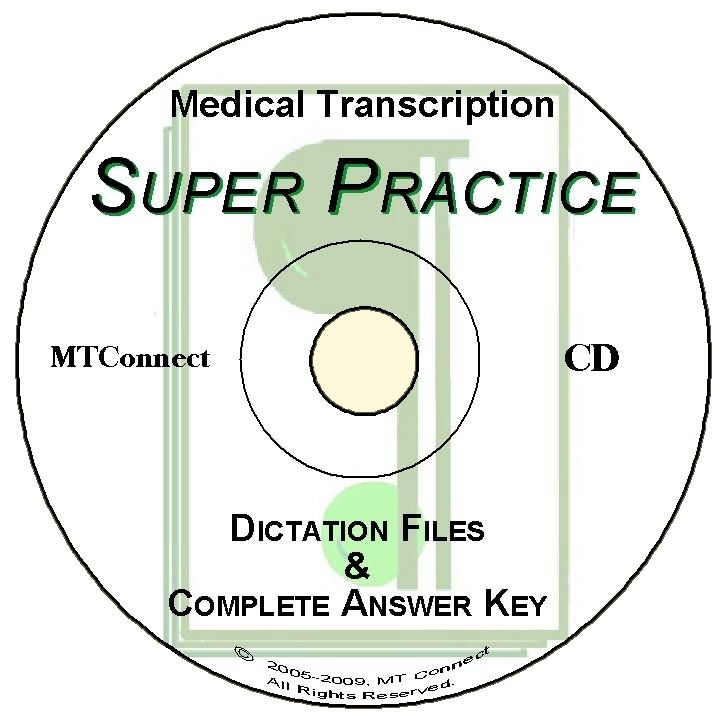
If you are looking for dictation files for practice, Super Practice, compiled by MT-Connect, has a collection of over 15 hours of dictation with complete answer keys. These dictation files reflect the real world of medical transcription. Included are a variety of practitioners, specialties, medical environments, dictating styles, accents, and dialects.


Who needs medical transcription practice files?
  • Anyone considering a career in medical transcription.
  • New medical transcriptionists who need practice.
  • Medical transcriptionists who have been away from their work and need to refresh or hone their skills.
  • Medical transcriptionists who want to expand their knowledge base.


Super Practice CD - $49.95


Shipping included.
----------------------------------         

Super Practice Download - $39.95


Please allow several hours for processing.
Digital files will be delivered to your email Inbox.
CD will ship within 24 hours.
             

Can We Talk

Voice recognition applications are becoming more popular. We are seeing speech-to-text in new places. The iPad 3 comes with built-in dictation capabilities. Siri made its debut via the iPhone. Medical offices have become increasingly more dependent on speech-to-text. The software continues to improve.

Although I have dabbled with speech-to-text on occasion, it had not been a rewarding experience. In fact, it was more a source of humor - speak into the microphone and see the ludicrous text that is produced. It is rarely a small error, but rather an error that induces laughter, unless, of course, you need it done right, and you need it right now!

I recently came across an offer to purchase Dragon Naturally Speaking at a very enticing price. It seemed the time has come for me to put forth serious effort. I was not looking forward to the training, which I understood to be time-consuming, but I expected the installation to go smoothly.

Installation on my Windows 7 computer did not go well. The first several attempts failed, producing an error message that a required file was missing. After some Internet research, the missing file was located, downloaded, and installed, and Dragon was finally ready.

Although there are pieces of information available, i.e., some voice commands are listed on the box, in an accompanying brochure, and in the on-screen Tip of the Day, it was made obvious that knowing and learning those commands is critical for success. For example, saying “quote” will not produce a quotation mark; saying “open quote” will. That seems trivial, but it is the difference between accomplishing a task and total frustration.


Help was not available. Investigation into the program’s Help revealed that it was written for Windows XP and earlier operating systems. Windows 7 (and Vista) do not recognize the format that was used. As illustrated, it is critical to know precise commands, and where else to find that information if not in Help!

With the location of user guides on the Internet (which I downloaded and made available here, under Blogroll on the sidebar), required information is now available. I also went through the tutorial. Dragon is now ready to use. I get better with practice and so does Dragon, and I am finding Dragon to be a fun and useful tool.

Some transcriptionists use Dragon to transcribe for them. Careful editing is then required, but transcription time is reduced, as is the stress on hands and wrists. Learning to edit can be an asset in itself as there are transcription jobs for speech-to-text editors. Experience with voice recognition software just might be the tool you need to get a job or land a new account as a medical transcriptionist.


Some Jobs Just Are Not Perfect

For every 60 minutes of audio, transcription time takes about 3-4 hours. This is an average. Some jobs go faster, others slower. Transcription time depends on many factors. Besides unfamiliarity with words and phrases that might require lookups, the recording itself usually poses the most challenges.

Quality of the recording is affected by:
  1. Hums and buzzes – sometimes recorded, sometimes it is the player's mechanism.
  2. Background noise – talking, cell phone ringing, music, etc.
  3. Speaker’s distance from microphone.
  4. Multiple speakers – interviews, focus groups, lectures, podcasts, broadcasts.
  5. Number of speakers talking at the same time.
  6. Faulty equipment – beeps, blips, fading sound, etc.
  7. Speakers’ accents and dialects.
  8. Mumbles and jumbles – uncorrected misspoken words, slurring, etc.
  9. Speed talkers – their goal to get done as quickly as possible.
  10. Transcriptionist’s attitude.
Many dictators ruin the otherwise perfect audio by eating, drinking, yawning, sneezing, and burping, as well as other “natural” bodily sounds while they talk. It often seems like the pause button must be broken.

My all-time least favorite audiofiles to transcribe were given to me regularly by a physician who liked to dictate chart notes while he drove home from the office. He preferred driving with the window open. In addition to the road noise captured on audio, the wind did a great job of drowning out his voice. Then there were the sounds of cars honking (undoubtedly at him) and every so often the sound of screeching tires. Besides the dictation being difficult to hear, I was a nervous wreck listening and imagining the nuisance he must have been on the road. I figured that if he got into a car crash (and I expected that to happen at any moment), I would get to hear it as it happened, and I was on edge waiting for that to happen.

Then there was the radiologist who flapped his films as he talked...

Have you had a transcription job that stands out as “the worst”?


Monday, January 14, 2013

Day to Day


Working from home or onsite, the medical transcriptionist's day can be intense. How the day actually passes and how others perceive the job can be quite diverse.  Wherever lies the truth, the medical transcriptionist gets the work done and gets it done right.